
Commercial Concrete in Brooklyn, NY
Sidewalks, dock aprons, pads, slabs and footings for commercial, mixed-use and multifamily property.
South Asia Construction Co. is a commercial concrete contractor in Brooklyn working on storefronts, mixed-use buildings, multifamily portfolios and small industrial sites across Brooklyn and Queens. We walk the site, price the scope in writing, and pour to the specification the location actually calls for. A frontage a truck crosses does not get the same pour as a walkway, and we do not price it as though it does.
Licensed & Insured
Pouring Since 1999
Free On-Site Scope
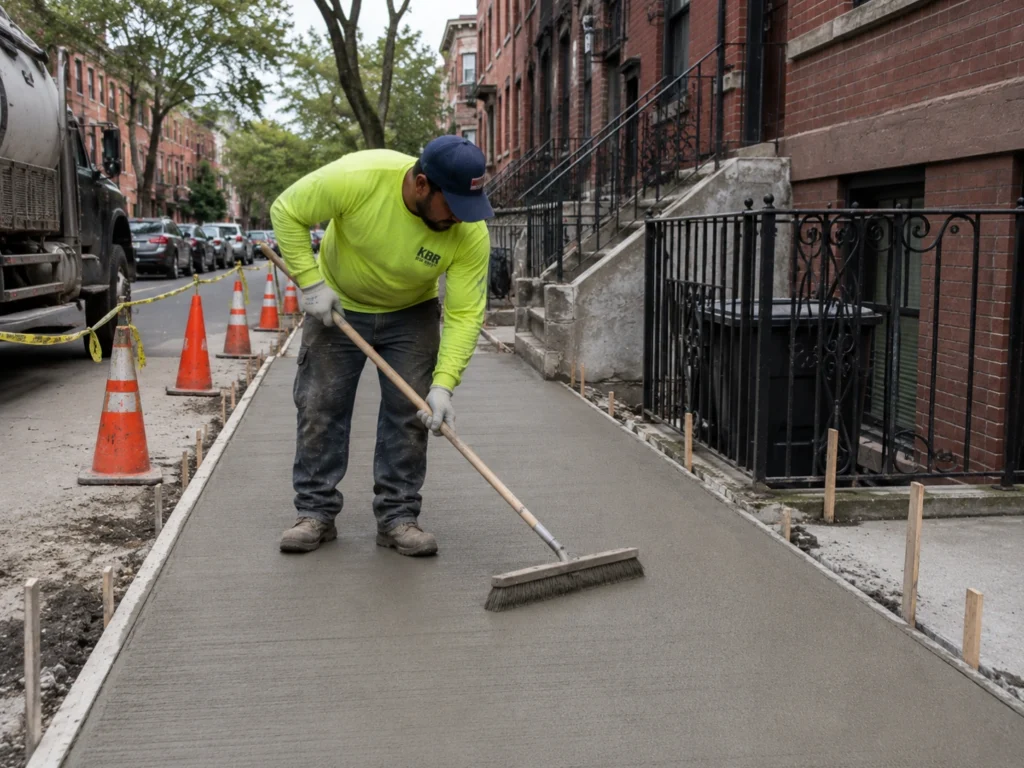


- New York City requires 4 inches of concrete over a 6 inch compacted foundation for standard sidewalk, and 7 inches at driveways and corner quadrants. Most commercial frontages contain both conditions.
- Sidewalk work over 25 square feet needs a New York City Department of Transportation permit. Below that, a permit is required only where the work removes a violation.
- Administrative Code §7-210 exempts only one-, two- and three-family homes that are owner-occupied and used exclusively for residential purposes. A ground-floor storefront removes the exemption.
- Early failure is almost never the concrete. It is sub-base washout, walking spec at a vehicle crossing, missing joints, salt scaling, root heave, or water standing where falls were never set.
- The correct scope is decided by what is under the slab, not by how the surface looks. A slab that sounds hollow needs replacement no matter how good the top looks.
- On an occupied building the access plan is priced before the concrete. Phasing and out-of-hours pours cost more and usually cost less than a closed door.
- Boards and managing agents approve a document, not a number. A scope broken out by zone is what makes two bids genuinely comparable.
- Commercial frontages in Brooklyn take more de-icing salt than any residential surface, so sealing does more for service life here than anywhere else on a property.
Commercial Concrete at a Glance
Commercial concrete is specified by what crosses each part of the site, so a single frontage often needs two or three different pours to be built correctly.
What Property Owners Say About Our Concrete Work
South Asia Construction Co. collects reviews on Google, Thumbtack and Networx from property owners and managers who hired the company for concrete and exterior work in Brooklyn and Queens.
Noor and his team are fast and efficient, all at a fair price. Noor is very clear about what work will be done and sets your expectations very clearly so there's no misunderstanding about the process and details why things are done. I recommend him and his team's services. I've attached some before and after pics.
Sam C.
Brooklyn

Noor and his team are great! Quick, responsive, and experienced. Highly recommend him and his team.
Samuel W.
Brooklyn
They did excellent work and kept me informed of any issues that needed attention. Would definitely recommend for any project you have. Also offers competitive rates.
Jermaine C.
Brooklyn
Did a great job sealing the cracks of my concrete and also helped with some accessory cracks and large stone removals!
Jib C.
Brooklyn
Working with Noor was great. He made the process effortless and the work was quick and done well. He and his team were very professional, communicative, and efficient. I will definitely be working with him again on other projects needed for my home.
Amina M.
Brooklyn
Had an amzing experiance with our roofing services done by them
Mohammed Raju
Brooklyn

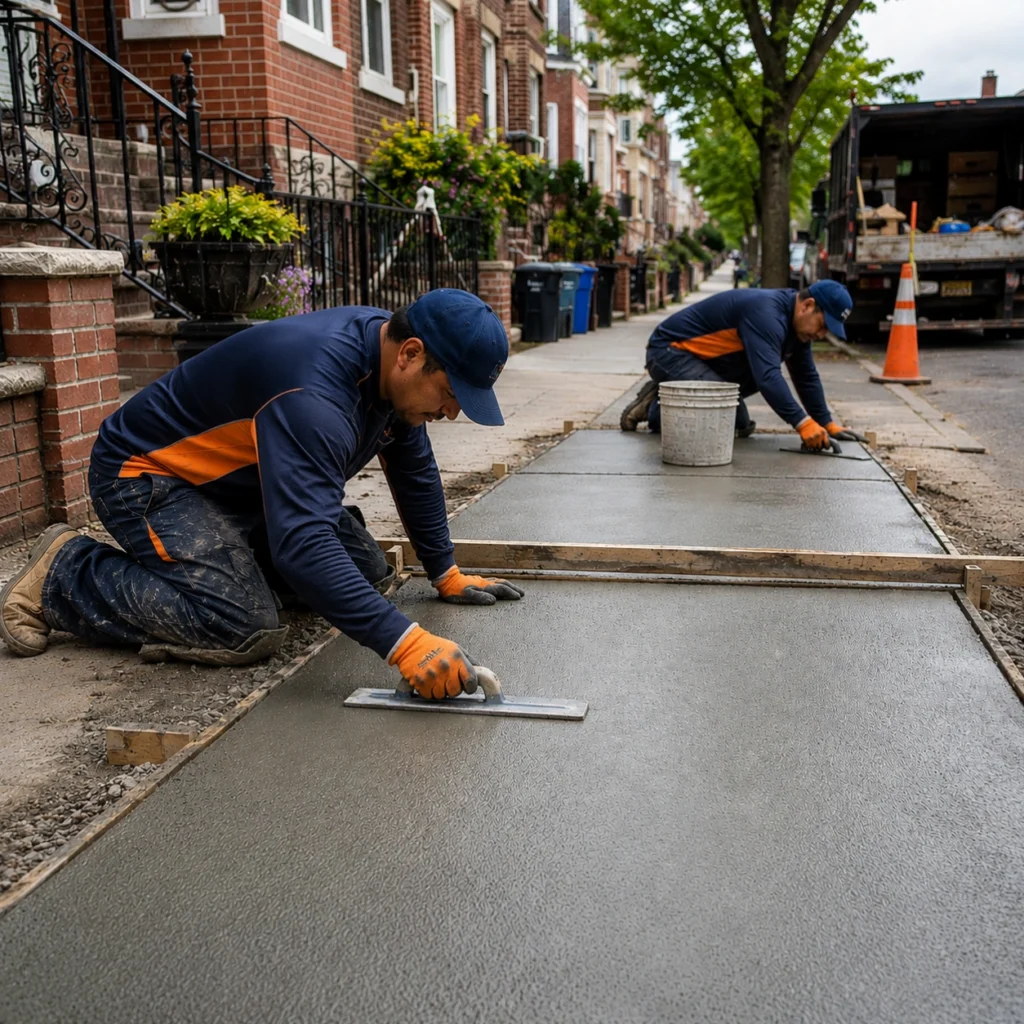
Commercial Concrete Is Specified by Location, Not by Building
Commercial concrete is concrete placed on property that carries vehicle load, public foot traffic, or an owner liability that cannot be transferred to a tenant.
That definition covers more Brooklyn property than most owners expect. A four-unit walk-up is commercial concrete. A three-family with a bodega on the ground floor is commercial concrete. A co-op frontage, a managed portfolio, a corner storefront and a truck-served yard all sit in the same category, because in every one of those cases the owner carries the repair obligation and the injury exposure.
The important part is that the specification changes across a single property line. New York City requires 4 inches of concrete over a 6 inch compacted foundation for standard sidewalk, and 7 inches at driveways and corner quadrants. A commercial building usually has both conditions inside one frontage. South Asia Construction Co. measures where the transition falls, pours each zone to its own spec, and shows you the split on the estimate before any work starts.
Concrete that is poured correctly still needs looking after. Road salt and de-icer are the fastest way to scale a commercial surface in Brooklyn, and a sealed slab holds its finish through far more freeze-thaw cycles than an unsealed one. If your surface is already scaling, concrete sealing and surface protection is a separate conversation from replacement.
What Each Surface Has to Be Built To
Commercial concrete is specified per location, and thickness, foundation depth, reinforcement, finish and joint spacing all change depending on what crosses the surface.
Where the Transition Line Falls
The transition between standard and vehicle-crossing spec sits at the edge of the crossing, not at the property line. On a Brooklyn frontage with a single curb cut, that usually means three separate pour zones inside forty feet of sidewalk. We mark those zones on the estimate drawing. If a bid you are comparing shows one thickness for the whole frontage, it is either priced light or specified wrong, and both cost you later.
Four Kinds of Commercial Concrete Work
South Asia Construction Co. groups commercial concrete into four scopes: public-facing frontage, vehicle-load surfaces, flat slabs and pads, and structural concrete.
Sidewalks, ADA Ramps & Curb Cuts
Public-facing concrete carries the highest liability of any surface on a commercial property, because the owner is answerable for every pedestrian who crosses it.
We replace full commercial frontages, correct trip hazards at slab joints, and build pedestrian ramps and curb cuts that meet ADA slope and detectable-warning requirements. Frontage work runs to NYC DOT specification, including 5 foot flag scoring and expansion joints at roughly 20 foot intervals, because that is what an inspection is measured against. If you are working from an open NYC DOT sidewalk violation, the violation page covers the notice and closeout process in full.
Loading Docks, Aprons & Vehicle Entrances
A dock apron is the concrete section between the street and the loading bay, and it takes the highest axle load anywhere on a commercial site.
Delivery trucks concentrate load at the point where they turn and brake, which is exactly where a standard 4 inch pour fails first. We pour vehicle-crossing sections at the thickened spec, set reinforcement through the load path, and stabilise the sub-base under it before anything is placed. When a dock apron cracks within two years, the sub-base is almost always the reason, not the concrete.
Parking Areas, Pads & Slabs on Grade
Slabs on grade cover parking areas, dumpster pads, equipment pads and warehouse floors, and they are priced by area, thickness and reinforcement together.
We pour and replace parking surfaces, dumpster enclosure pads, generator and HVAC equipment pads, and interior floor slabs. Drainage falls get set at the layout stage, not corrected afterwards, because a flat commercial slab that ponds water will scale at every low point within a few Brooklyn winters. We mark the falls on the estimate drawing so you can see where water is going before we pour.
Footings, Foundation Walls & Retaining Walls
Structural concrete carries building load or retains soil, and it is poured to the engineer's drawing rather than to a standard detail.
We place footings, foundation walls, pilaster pads and retaining walls on commercial and multifamily property, working to the drawing your engineer or architect issues. On below-grade work we coordinate the pour sequence with below-slab waterproofing so the membrane goes in at the right stage instead of being retrofitted later. Where a job needs an engineer's stamp, we work under the engineer. We do not replace one.
Whichever scope applies, the sequence South Asia Construction Co. runs on a commercial site is the same four stages.
Repair, Partial Replacement or Full Replacement
A surface that looks alarming can be sound underneath, and a surface that looks acceptable can be sitting on nothing. South Asia Construction Co. uses the table below at every site walk, and we will tell you when the smaller scope is the right one even though it is the smaller invoice.
Sounding means tapping across the panel and listening for the hollow note that says there is a void underneath. Level across joints tells us whether one flag moved or the whole run did. Probing at the worst point tells us whether the base is still there. Those three checks take about fifteen minutes and they decide the entire price, which is exactly why South Asia Construction Co. will not quote commercial concrete from a photograph.
In that situation replacing the whole frontage is money spent on concrete that was not failing. We will say so. What we will not do is patch a run where the base has gone, because the patch bridges a void, breaks in one winter, and you pay for the full job anyway plus the patch you already bought.
Once the scope is settled, the sequence South Asia Construction Co. runs on a commercial site is the same four stages.
How a Commercial Pour Runs, Start to Finish
Site Walk & Written Scope
We walk the site, measure each zone, identify where the specification changes, and issue a written scope with a fixed price before anything is scheduled.
The scope names the square footage per zone, the pour thickness for each, the reinforcement, the sub-base work, the permit position and the number of working days. That document is what a managing agent hands to a board. We do not quote commercial concrete over the phone, because the thing that moves the price most is the sub-base, and nobody can see the sub-base from a phone call.
Permits, Staging & Protection
Sidewalk work over 25 square feet requires a New York City Department of Transportation permit, and South Asia Construction Co. pulls it as part of the job.
Below 25 square feet a permit is required only where the work removes a violation, and a commercial frontage is almost always above the threshold anyway. We also set the pedestrian route, the barrier line and the protection for tenant and customer access before demo starts. On a live retail frontage we agree the staging plan with you first, because losing the door for a day costs the tenant more than the concrete does.
Demo, Sub-Base & Reinforcement
We remove the old concrete, haul it off site, then build and compact a 6 inch stone foundation before any reinforcement is set.
The foundation is clean broken stone, recycled concrete or granular material, tamped and compacted to the standard the City specifies. Where the ground has been undermined by tree roots, a leaking line or fill settlement, we stabilise it and note it on the scope rather than pouring over it. On foundations and structural slabs the reinforcement follows the engineer’s schedule.
Pour, Cure & Closeout
We pour each zone to its own thickness, finish to the required texture, then protect the surface through the full cure window before reopening it.
Frontage work gets a broom finish and scored joints at the City’s spacing. Cured surfaces stay protected for at least 96 hours, which is the standard the City’s own specification sets. At closeout you get photographs of the sub-base and reinforcement taken before the pour, which is the part nobody can inspect afterwards, plus the permit record and the workmanship warranty.
What We Need From You Before Day One
South Asia Construction Co. needs three things to start a commercial job: the signed scope, the access and delivery windows, and a named contact who can make a decision on site.. On a Brooklyn frontage with a single curb cut, that usually means three separate pour zones inside forty feet of sidewalk. We mark those zones on the estimate drawing. If a bid you are comparing shows one thickness for the whole frontage, it is either priced light or specified wrong, and both cost you later.
Written scope and fixed price before anything is scheduled.
Stage two is where most commercial buildings discover a liability position they did not know they were in.
Permits, Accessibility and Who Signs Off
South Asia Construction Co. establishes the compliance position at the site walk and states it on the written scope, because a job that starts without the right permit stops at the first inspection.
NYC DOT Sidewalk Permit
Sidewalk work over 25 square feet requires a New York City Department of Transportation permit.
Below that threshold a permit is required only where the purpose of the work is removing a violation. A commercial frontage is almost always above 25 square feet, so assume the permit applies. We pull it as part of the job rather than handing you a form.
Accessibility Requirements
Pedestrian ramps and curb cuts on commercial property have to meet slope, width and detectable-warning requirements under the Americans with Disabilities Act.
A ramp poured to the wrong slope is a compliance exposure as well as a hazard, and it is not something you can correct with a grinder afterwards. We set ramp geometry at the forming stage and check it before the pour.
Structural Sign-Off
Footings, foundation walls, retaining walls and load-bearing slabs fall under Department of Buildings jurisdiction and need an engineer's or architect's drawing.
South Asia Construction Co. pours to that drawing. We do not produce it and we do not substitute for it. If you do not have a designer engaged yet, we will tell you at the site walk rather than after you have paid a deposit.
Special Districts
Frontages inside a landmarked or special district can carry additional review before non-standard materials or finishes are approved.
Parts of Brooklyn Heights, Boerum Hill, Fort Greene, Park Slope and Bedford-Stuyvesant sit inside historic districts. If your frontage does, we flag it before the scope is priced so the approval time is in the schedule rather than a surprise in the middle of it.
Requirements above are stated in general terms. Permit fees, approval timelines and district boundaries change, so South Asia Construction Co. confirms the current position for your specific address at the site walk rather than publishing figures that go stale.
Compliance decides whether the job can start. Site conditions decide how it runs once it does.
Working Around Tenants, Customers and Deliveries
A commercial concrete job on an occupied building is planned around access first and concrete second, because the cost of a closed door usually exceeds the cost of the pour.
This is the part residential contractors get wrong on commercial work. South Asia Construction Co. agrees the access plan with you before demo, and the plan goes on the written scope so a managing agent can circulate it to tenants ahead of the start date.
Access shapes the schedule. Liability shapes the urgency, and most commercial owners are carrying more of it than they realise.
Most Commercial Buildings Are Not Exempt From Sidewalk Liability
New York City Administrative Code §7-210 makes the abutting property owner liable for sidewalk injuries, and it exempts only one-, two- and three-family homes that are both owner-occupied and used exclusively for residential purposes.
Read that exemption carefully, because it fails in three common Brooklyn situations. A four-unit building fails on unit count. A two-family owned by a landlord who lives elsewhere fails on owner occupancy. A three-family with a ground-floor storefront fails on exclusive residential use, even though it is small and even though the owner lives upstairs. In each of those cases the building carries full liability for an injury on the sidewalk in front of it.
That is a separate matter from a repair notice. A NYC DOT sidewalk violation notice tells you the City wants the concrete fixed. §7-210 is about who pays when somebody trips on it. A building can be exempt from neither, and a commercial building almost never is. South Asia Construction Co. raises this at the site walk because it changes what “we will patch it for now” actually costs you.
What This Means for a Mixed-Use Building
A mixed-use building carries sidewalk injury liability in full, regardless of how many residential units sit above the commercial floor. That is the situation most Brooklyn owners get wrong. The exemption is written as three conditions joined by “and”, so failing any one of them removes it entirely. If there is a store, a salon, a clinic or an office anywhere in the building, the exclusive-residential-use condition has already failed.
The notice is a repair order, not a fine. Fixing it properly closes it. Fixing it badly means doing it twice.
Do not wait. The longer you leave it, the more it costs. Get a free on-site assessment and we will walk you through the full process.
Permits, Six Reasons Commercial Concrete Fails Earlyand Who Signs Off
South Asia Construction Co. establishes the compliance position at the site walk and states it on the written scope, because a job that starts without the right permit stops at the first inspection.
Sub-Base Washout
Water moving under a slab carries the base material away and leaves a void the concrete then spans unsupported.
A leaking service line, a downpipe discharging at the slab edge, or a joint that has been open for two winters will all do it. The slab cracks along the void, not where the surface looked worst. This is the single most common cause of early failure on Brooklyn commercial frontages.
Walking Spec at a Vehicle Crossing
Concrete poured at sidewalk thickness where a vehicle crosses will crack through, usually inside two winters.
The City sets a heavier requirement at driveways and corner quadrants for exactly this reason. A contractor who pours one thickness across the whole frontage saves a few hundred dollars and costs you the crossing.
Missing or Misplaced Joints
Concrete shrinks as it cures, and without control joints at the right spacing it chooses its own crack lines.
Joints have to be cut at the correct depth and at the correct interval, and on a frontage they also have to align with the flag layout. Joints cut too shallow do nothing. Joints cut too late do nothing.
De-Icing Salt Scaling
Road salt drives freeze-thaw cycling inside the surface layer and flakes concrete off in sheets.
Commercial frontages get more salt than any residential surface in the city because they get salted by the building, by the tenant and by the plough. An unsealed commercial slab in Brooklyn loses surface far faster than the same mix in a rear yard.
Tree Root Heave
London plane and other street trees lift sidewalk flags from below as the root plate expands.
Replacing the flag without addressing the root condition produces the same heave again. We assess root position at the site walk and specify the panel layout and base treatment around it rather than pouring straight back over it.
Ponding and Wrong Falls
A flat commercial slab that holds water will scale at every low point and ice over every winter.
Falls are set at the layout stage. They cannot be corrected afterwards without re-pouring. Any slab that ponds after rain was laid without a defined outlet, and no sealer or coating will fix the geometry.
Those six causes are visible in the work we have completed, so here is what the finished jobs look like.
Recent Commercial Concrete Projects
Commercial frontages, dock aprons and pads completed for property owners and managing agents across Brooklyn and Queens.
Commercial Frontage Replacement
A full sidewalk frontage at a [PROPERTY TYPE] was removed and replaced to NYC DOT specification after joint separation and slab settlement made the surface a trip hazard across the whole width.
Loading Dock Apron Rebuild
Old The apron at a [PROPERTY TYPE] loading entrance had cracked through at the turning point where delivery trucks brake. We removed the failed section, stabilised the sub-base, set reinforcement through the load path and poured at the vehicle-crossing thickness.concrete was removed and replaced with a cleaner, safer sidewalk surface for a Brooklyn residential property.
Equipment Pad & Rear Yard Slab
A [PROPERTY TYPE] needed a level, drained rear yard slab and a dedicated pad for relocated mechanical equipment. We set the falls away from the building line, poured both sections in one visit and finished the slab for foot traffic.
What separates those jobs from the ones that come back is a short list of decisions made before the truck arrives.
Five Checks That Decide Whether a Commercial Pour Lasts
Use the table below on any bid you receive, including ours. South Asia Construction Co. publishes these because a building owner who knows what to ask ends up with better concrete regardless of who pours it.
Those five decisions are also the five biggest inputs into what a commercial job costs.
How Long Each Surface Should Last
South Asia Construction Co. publishes the ranges below so a managing agent can plan replacement into a capital cycle instead of reacting to a failure. Every figure is a realistic planning range for correctly specified concrete, not a warranty.
Correctly specified commercial concrete is a long-cycle asset. Most early replacement in Brooklyn is not the concrete wearing out, it is one of the six failure causes above arriving inside the first few winters. Confirm the workmanship warranty term with South Asia Construction Co. in writing before you sign.
Extending service life on a salted commercial frontage almost always comes back to concrete sealing and surface protection, which is a separate scope with its own reseal cycle.
Those five decisions are also the five biggest inputs into what a commercial job costs.
What Commercial Concrete Costs in Brooklyn
Ranked from largest impact to smallest. Every job gets a written price before scheduling.
Required Thickness and Reinforcement
Thickness is the single largest cost driver on a commercial job. A vehicle crossing or corner quadrant needs materially more concrete per square foot than a standard walking surface, and it needs reinforcement the walking surface does not. Two frontages of identical size can differ substantially in price purely because one has a loading entrance in it.
Sub-Base Condition
What is under the old slab is the biggest unknown until demo. Ground undermined by tree roots, a leaking line, or fill settlement has to be excavated and stabilised before the new pour, and that work is not visible from the surface. We flag suspected sub-base problems at the site walk and price the stabilisation as a named line so it is not a surprise after demo.
Total Area and Number of Zones
Area sets the base number, but the count of separate zones sets the labour. A single 400 square foot pour costs less than four separate 100 square foot pours on the same property, because each zone needs its own forming, its own edge treatment and its own finish pass.
Permits, Staging and Work Hours
Permit cost applies to frontage work above the 25 square foot threshold. Staging cost depends on how much protection the site needs to keep tenants, customers and pedestrians moving. Night and weekend work costs more than daytime work, and on a live retail frontage it is often still the cheaper option once lost trading hours are counted.
Access and Phasing
Tight access, no truck standing room, blocked frontages and slabs that sit tight against utilities all add setup time. Phasing a job so half the frontage stays open costs more than closing the whole width for a shorter period. We price both options where the site allows it, so you can choose between cost and disruption rather than being handed one answer.
Combine zones into one mobilisation. The single largest avoidable cost on commercial concrete is paying for setup twice. If the frontage, the rear yard pad and the dock apron all need work inside twelve months, doing them in one visit removes a full mobilisation from the price.
Repair before it becomes replacement. A frontage with two failed flags is a partial job. The same frontage two winters later, after water has worked through the joints and undermined the base, is a full replacement plus sub-base stabilisation.
Do not pay for decorative finish on a service area. A rear yard slab, a dumpster pad and a dock apron gain nothing from a finish upgrade. Put the budget into thickness and reinforcement instead.
We will not patch a frontage that needs replacing. If the sub-base is gone under the run, a patch buys you one winter. We will tell you that at the site walk, and if a patch is what you want, we will decline the job rather than take money for something we know will fail.
We do not provide structural design. If your work needs an engineer’s stamp, you need an engineer. We pour to their drawing. We do not produce it.
We are a Brooklyn and Queens contractor. We do not take commercial work in Manhattan, the Bronx, Staten Island or Long Island, because the response times a commercial client needs do not survive that travel.
A full list of what South Asia Construction Co. pours is on the all concrete services hub.
Where your building sits also changes the job, because the commercial corridors of Brooklyn and Queens each present a different set of ground conditions.
Concrete, Asphalt or Pavers
South Asia Construction Co. pours concrete, so treat this table as the case each material makes for itself rather than a neutral referee. Public sidewalk frontage in New York City is not a choice, because the City specifies concrete.
One rule cuts through most of this. If a truck will stand still on it, pour concrete. If something under it will need digging up on a cycle, do not.
Whichever material fits, where your building sits changes the ground conditions underneath it.
Commercial Concrete Across Brooklyn and Queens
Eight corridors where most of our commercial work sits, and what each one does to concrete.
01
Sunset Park & Industry City
Converted warehouse frontages with heavy truck turning movements. Aprons here take axle load that residential spec cannot carry.
02
Gowanus & Third Avenue
03
Atlantic Avenue
04
Flatbush Avenue Corridor
05
Long Island City
06
Maspeth & Middle Village
07
Flushing & Main Street
08
Jamaica Avenue
More detail on coverage sits on the Brooklyn service area page.
Six questions come up on nearly every commercial site walk, so here are the answers in advance.
What You Receive to Get the Work Approved
Written Scope by Zone
Every zone is listed separately with its square footage, pour thickness, reinforcement and sub-base treatment.
This is what lets a board compare bids honestly. Two prices for the same frontage mean nothing until you can see whether both are pouring the crossing at the correct thickness.
Fixed Price, Held
The written price does not change once you sign it, and any sub-base risk we suspect is priced as a named line before you commit.
Boards approve a number, not a range. Discovering a variation after demo is how a straightforward job turns into an emergency meeting.
Permit Position Stated
The scope states which permits the work needs and who is pulling them.
For frontage work above the threshold that is South Asia Construction Co., as part of the job. It is written down so nobody discovers on day one that it was assumed to be somebody else’s task.
Schedule and Access Plan
You get working days, phase sequence and the reopening date in a form you can forward to tenants without rewriting it.
On a live retail frontage this document does more to keep tenants calm than anything else we hand over.
Pre-Pour Photographs
We photograph the sub-base and reinforcement before the concrete goes in, because that is the part nobody can inspect afterwards.
This is the record that proves the job was built to the scope that was approved. Keep it with the building’s capital file.
Warranty and Closeout
At completion you receive the workmanship warranty in writing along with the permit record.
Confirm the warranty term with us before signing. A warranty that is described verbally and never written down is not a warranty.
If anything above is still unclear, these are the questions that come up on nearly every commercial site walk.
Commercial Concrete Questions We Get Asked
Do you handle concrete for commercial and mixed-use buildings?
Yes. South Asia Construction Co. works on commercial, mixed-use, multifamily and small industrial property across Brooklyn and Queens, including co-op and condominium buildings and managed portfolios. We take frontage work, dock aprons, parking areas, pads, slabs and footings. We do not take work outside Brooklyn and Queens.
Is my building exempt from sidewalk injury liability?
New York City Administrative Code §7-210 exempts only one-, two- and three-family homes that are owner-occupied and used exclusively for residential purposes. A building fails that test if it has four or more units, if the owner does not live there, or if any part of it is used commercially. Most commercial and mixed-use buildings in Brooklyn are not exempt. Confirm your own position with your attorney or insurer, since the answer depends on your specific ownership and use.
How much does commercial concrete cost?
Commercial concrete is priced on site, because the two biggest drivers are pour thickness and sub-base condition, and neither can be assessed remotely. We measure each zone, price it in writing, and the written number does not change once you sign it. The largest cost drivers, ranked, are set out in the cost section above.
What documentation do we get for board or owner approval?
You get a written scope broken out by zone, showing square footage, pour thickness, reinforcement, sub-base work, permit position and working days. Managing agents and boards use that document directly for approval. At completion you also get photographs of the sub-base and reinforcement taken before the pour, the permit record and the workmanship warranty.
How thick does concrete need to be at a loading entrance or curb cut?
New York City requires 4 inches of concrete over a 6 inch compacted foundation for standard sidewalk, and 7 inches at driveways and corner quadrants. Any point where a vehicle crosses the frontage falls under the heavier requirement. Pouring the thinner spec across a vehicle crossing is the most common reason a commercial frontage cracks within two years.
Can you work nights or weekends to keep the business open?
Yes. We run night and weekend pours on live retail and commercial frontages, and we phase work so part of the frontage stays open where the site allows it. Both options cost more than a straight daytime closure. On an active storefront the phased option is often still cheaper once lost trading hours are counted, and we price both so you can compare.
Do you work directly with managing agents and boards?
Yes. South Asia Construction Co. works with managing agents, co-op and condominium boards, and commercial landlords across Brooklyn and Queens. We issue the scope in a form an agent can circulate without rewriting it, and we deal with a named decision-maker on site so the job does not stop while a question waits for the next board meeting.
What happens if you find a problem after demo?
We flag suspected sub-base problems at the site walk and price the stabilisation as a named line before you sign, so the common surprises are already in the number. If something genuinely unforeseeable appears once the slab is out, we stop, photograph it, and give you the revised figure in writing before continuing. We do not carry on and invoice the difference.
Will the new concrete match the existing sidewalk?
New concrete is always lighter than aged concrete and takes months to weather toward the surrounding colour. We match the finish, the joint layout and the flag dimensions so the new work reads as part of the same frontage, but an exact colour match on day one is not achievable and any contractor who promises it is guessing. On a partial replacement we will tell you honestly how visible the join will be before you choose the scope.
How long before we can use the surface?
Foot traffic can usually return within about a day, and full load takes considerably longer. We keep the protected route and barriers in place through the cure window, which follows the City’s 96 hour standard on frontage work, rather than reopening early. On a dock apron or a parking surface the vehicle return date is set by the specific mix and conditions, and we give you that date in writing at the start of the job.
Related Services
All Concrete Services
Every concrete service South Asia Construction Co. provides across Brooklyn and Queens, residential and commercial.
Sidewalk Repair & NYC DOT Violations
The full violation process: what the notice means, how the repair is specified, and how the closeout works.
Foundations & Slabs
Footings, foundation walls and structural slabs poured to engineer's drawings.
Ready to price the concrete work on your building?
Send us the address and what you are seeing. We will walk the site, measure each zone and put a written number in front of you at no cost.